You incorporated too early. Now the admin is becoming a burden: what should you do?
What to do when a limited company is creating more administration than the business needs, including unnecessary add-ons, dormancy, strike off and returning to sole trader status.
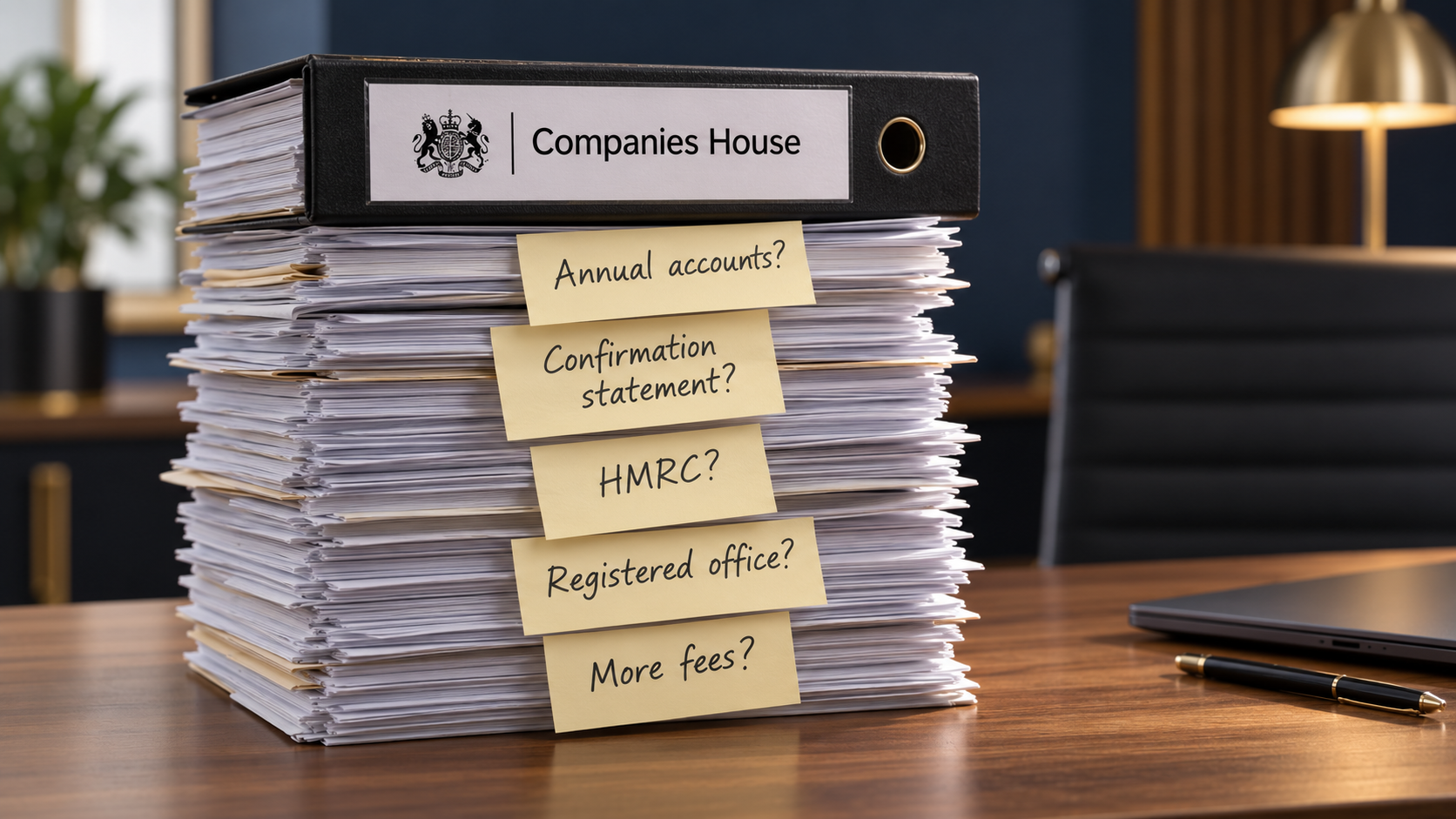
For people who have spent years around businesses, the decision whether to incorporate can feel fairly ordinary. For someone starting their first business, it often does not. There is still a surprisingly common assumption that forming a limited company is simply what you are supposed to do once an idea becomes a “real business”. Some people believe having “Limited” after the name makes them more legitimate. Others are attracted by the idea of limited liability and assume that incorporation will substantially separate everything that might go wrong in the business from them personally. Formation websites do little to discourage either impression, particularly when forming a company can be made to look like a five-minute administrative exercise followed by a shopping list of additional services.
None of that means incorporating is inherently a bad decision. A limited company can be exactly the right structure. It can provide a useful separation between the individual and the business, may be expected by certain customers or contracting parties, and can make sense for a business which is growing, taking on risk, bringing in other owners or planning for investment. The problem is when incorporation comes before the underlying question: what does this particular business actually need? If the answer six months later is that you have created a company which earns very little, has little meaningful liability exposure and now costs time and money simply to maintain, it is perfectly reasonable to revisit the decision.
Work out whether the company has actually traded
The first thing to establish is whether the company really is unused or whether it has traded. Those are not the same situation. Someone who incorporated a company, opened an account and then never actually commenced business is in a very different position from someone who has invoiced customers, received money, incurred liabilities, entered into contracts or moved assets through the company. Once trading has happened, the company cannot simply be mentally erased because you have decided that being a sole trader would have been easier. There may be Corporation Tax, accounting, VAT, PAYE, contractual or asset issues to deal with before you change course. Where the company has never traded, the route out may be considerably simpler.
That distinction is also important because founders often use phrases such as “I never really used it” rather loosely. A handful of invoices, payments through the company bank account or expenses paid on the company’s behalf may still matter. Before deciding whether to keep the company, make it dormant or close it, establish what has actually happened rather than starting from what you intended to happen.
The incorporation fee is rarely the expensive bit
One of the less attractive parts of the company formation industry is the way a cheap and simple registration can become the gateway to a catalogue of additional products. Some are useful. Some may be appropriate for a particular business. Others appear principally designed to monetise the fact that a first-time founder does not yet know what they need.
We have seen a formation provider offer an £82 plus VAT “review” to determine whether a newly formed company needed to pay the Information Commissioner’s Office data protection fee. For context, the current ICO fee for a micro-organisation is £52 a year, reduced to £47 if paid by Direct Debit, and the ICO itself provides a self-assessment process to help businesses determine whether the fee is payable at all. In other words, in the case we saw, the charge for reviewing whether the business needed to pay the regulatory fee was greater than the regulatory fee itself.
That does not mean every add-on offered during incorporation is unnecessary. It does mean founders should pause before assuming that something presented alongside company formation is automatically either legally required or good value. Registered office services, mail forwarding, compliance packages, accounting subscriptions, document bundles and various forms of “protection” can all sound essential when you have never run a company before. Sometimes they are useful. Sometimes the basic decision should simply be to deal directly with the relevant regulator, accountant, bank or adviser and pay only for what the business actually needs.
That principle continues after incorporation. A very small company does not need to acquire an administrative infrastructure simply because larger companies have one. There will be genuine legal obligations, and those need to be met properly, but there is a substantial difference between complying with the law and buying every product marketed as “compliance”.
Keeping it, making it dormant or closing it
If the business still makes sense through a limited company, the answer may simply be to simplify what has grown around it. Review the subscriptions, external services and processes you have accumulated and ask what is genuinely required. There is little merit in closing a company which is commercially useful merely because its administration has been allowed to become unnecessarily complicated.
If the business is paused rather than finished, keeping the company dormant may be sensible. There can be perfectly legitimate reasons to retain a company which is not currently trading, particularly where there is a realistic intention to restart. Some people also form companies largely because they want to secure a particular company name. That can occasionally be worthwhile, but it should not be confused with comprehensive protection of a brand. Registering a company name at Companies House is not the same as owning a registered trade mark, and an existing business may in some circumstances have rights arising from its prior trading and goodwill even without having incorporated under that name. Brand protection is a separate question and should be treated as one.
If there is no realistic reason to preserve the company, closing it can be the sensible answer. A solvent company which is no longer required may be eligible for voluntary strike off. The current digital application fee is £13, although eligibility rules apply, including restrictions where the company has traded or changed its name within the previous three months. Closing the company also means actually closing its affairs. Contracts, employees, tax, creditors, bank accounts, assets and anything else belonging to the company need to be considered before it disappears from the register. Strike off is straightforward in the right case, but it is not a substitute for dealing with an insolvent company or leaving unfinished liabilities behind.
It is particularly important not to leave valuable property inside a company and then allow it to be dissolved. Money, intellectual property, domain names and other assets do not cease to exist merely because the company does. Property left behind can become bona vacantia and pass to the Crown. A founder who closes a company without first dealing with what it owns can therefore create a much more awkward problem than the one they were trying to solve.
Going back to being a sole trader is not failure
Sometimes, after looking at the numbers and the administrative burden, the answer really is that the business would work better as a sole trader. There is nothing inherently unsophisticated about that. Plenty of successful businesses operate without a limited company because that structure suits the level of risk, ownership and activity involved.
Where a company has already traded, moving the business back to the individual still needs to be done properly. The company and its director are separate legal persons. The company’s money is not simply the director’s money, and contracts, assets or intellectual property belonging to the company cannot simply be treated as personal property because the director has decided to stop using the corporate structure. This is one of the points at which a modest amount of professional advice can save considerably more work later.
There can also be an emotional resistance to reversing the decision. Closing the company can feel like admitting that the original plan did not work. Keeping it can feel like keeping the business alive. Emotion is not irrelevant in business and sometimes instinct matters enormously, but structure decisions ultimately need to work for the people and businesses affected by them. Directors have responsibilities. Creditors need to be protected. Customers and clients need to know who they are dealing with. A company should not be kept alive indefinitely simply because closing it feels uncomfortable.
Choose for the business you have now
Perhaps the most useful way to look at premature incorporation is not as a mistake which needs to be defended, but as a decision made with the information available at the time. Businesses change. Plans become smaller or larger. Risks emerge or disappear. What seemed like the obvious structure at the beginning may not be the right structure twelve months later.
If the company still serves a purpose, keep it and run it properly. If it is temporarily unused, dormancy may be appropriate. If it has become an unnecessary administrative shell, close it properly and move on. The objective is not to prove that incorporating was the right decision. It is to choose the structure which makes sense for the business you actually have now.
 Practical support. Real solutions.
Related insights



When the issue is live, context matters.
Aubrey International supports employers and businesses with sensitive employment, commercial and regulatory matters where an independent view or practical additional support is needed.